Showing posts with label information. Show all posts

11.13.2007

宝塚歌劇団 -- The Takarazuka Revue


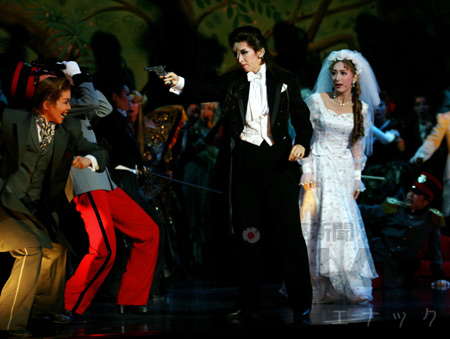
The post this time deals not with a drama review like usual, but instead with Japan's one and only all-female acting and singing revue: Takarazuka. While studying abroad, by chance I ended up going to see one of the plays, "Elisabeth," with my roommate and her friend. My roommate's friend was a big Takarazuka fan, and while I only went with them to the convenience store for company while they bought their tickets, I ended up purchasing one as well. I'd heard various things about Takarazuka before, but never really researched it. Odd as the concept of women dressing up and strutting around the stage pretending to be men might be to a lot of Westerners, it really was a treat and I really, really enjoyed it.

The first thing you notice when you get off the Hankyuu train line in the city of Takarazuka are the buildings. Just off the station there is a long road lined with European-style buildings, and if you're there around one of the showtimes, the street, called "Hana no Michi" (Road of Flowers), is full of women headed for the theater complex. The theater itself is large, white, and pretty hard to miss. The inside gleams, and everyone either wanders around looking at the treats for sale in the shops, takes pictures in front of the elaborate costumes on display in the windows of the costume shops, or goes to find their seat. And when I said that Hana no Michi was full of women, I wasn't kidding-- I believe I saw a grand total of five men in the theater that day, all of them with wives or girlfriends.

The fact that it was in a foreign language aside (though I was thanking my lucky stars for the little English summary of the play that was there), the acting and singing were surprisingly very, very good. It was a little odd at first to see a woman singing and speaking in a very low tone, hair slicked back and mustache plastered onto her face, but once I adjusted to it and got into the play, I loved every second of it.

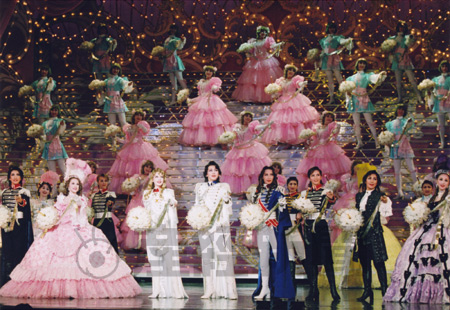
Now, I had been warned about what happens at the end of plays ahead of time, but it was still rather... surprising. For two hours, guests are entertained with a romantic, dramatic play with sweeping music and gorgeously complicated costumes, then all of a sudden, you're transported to Las Vegas. I kid you not, the sparkly stairs come out, the girls line up in big feathery outfits and all start doing the can can. I'm not entirely sure how this particular part of things got started, but it's good for a laugh-- so long as you do it silently.

Takarazuka was started in 1913. Back then, the city of Takarazuka was still small, its main attraction the hot springs. As an attempt to get more customers to come to the springs, the president of Hankyuu Railways pulled together a bunch of young, unmarried girls and had them begin performing in 1914. It officially became Takarazuka Kagekidan in 1940, and the girls split into groups: Hoshi Kumi (Star), Yuki Kumi (Snow), Tsuki Kumi (Moon), and Hana Kumi (Flower), with Sora Kumi (Cosmos) being added in 1998. Every year, each group puts on a play both at Takarazuka and at the Takarazuka theater in Tokyo.

To become a Takarazuka star, girls have to apply to Takarazuka Ongaku Gakkou, or the Takarazuka Music School. It's a very strict school, and out of the many people who apply, only 40 to 50 people are accepted each time. For two years the students learn singing, various forms of dance, and performing. There are around 400 people in the school, aged 15 to 18, and the first year students must learn to properly respect their sempai (upperclassmen). One of the duties of the lowly first years is to clean the school by hand. Once students have gotten past this first year, they are split into male roles and female roles, and the studying continues for quite some time before they are given their shot at lead roles.

There are varying kinds of performances. Famous Western musicals and novels (Elisabeth, West Side Story, Gone With the Wind, A Tale of Two Cities, etc.) are often played out upon the Takarazuka stage, as well as some plays based on Japanese comics (Rose of Versailles, for example). There are also Japanese historical plays.

Seriously, if you are going to be in Osaka any time soon, look into getting tickets. They are pretty cheap: I believe I paid around $50 for mine, and we were in the middle range of seats. Even if you can't understand what they're saying, the singing is wonderful, the costumes are great to look at, and the Las Vegas dance at the end is just plain amusing. I believe there is even an English phone number you can call to purchase tickets... but don't ask me where it is. Still, if you're interested more or have questions, let me know!

Takarazuka Revue English Site

10.22.2007

Music in Dramas

Similar to American dramas, popular music is often used in Japanese dramas, and the music often has a special link to the popular male drama actors: it is often them singing.

Johnny’s Entertainment is the powerhouse behind the popular music market in Japan. Started by Johnny Kitagawa in 1963, it has spent the last four decades churning out boyband after boyband after boyband. While it doesn’t work with female singers at all, the bands produced by Johnny’s consistently top the charts of single and album releases as well as musical DVD sales. It is very nearly impossible to step outside your house in Japan or watch more than a few minutes of T.V. without seeing one of the idols, for they are in stage plays and dramas, hosting or guesting on variety shows, posing in ads and commercials for random products, promoting their music or dramas, or being talked about on celebrity gossip programs virtually all hours of the day and night. Thousands and thousands of girls and women of all ages flock to their plays and concerts and drop money left and right in stores that sell official pictures or paparazzi pictures and goods which bear the faces of their favorite idols. The idols are literally everywhere.

The success of a popular drama often hinges upon the actors in it. While there are very well-liked actors not in Johnny’s Entertainment (JE for short), such as Matsuda Shota and Oguri Shun, many of the most popular dramas have members of JE in lead roles. Oftentimes, the script for a drama is written with a specific singer/actor in mind. The lead actors are most often from the debuted groups of the company (NEWS, KAT-TUN, Kanjani8, Tackey & Tsubasa, Arashi, SMAP, V6, TOKIO, KinKi Kids, Golf & Mike, Shounentai, and the brand new Hey! Say! JUMP), but there are many more Juniors (un-debuted members) who also continue their long climb to fame by taking smaller roles in dramas. Kimura Takuya of SMAP is perhaps the idol most renowned for his acting, having appeared in 28 dramas and a handful of movies.

If there is a member of JE in a drama, there is a pretty good chance that one of their songs will be a theme song for a drama. Sometimes there will be a song during the opening sequence and sponsor list. More commonly, the song will be either an insert song, usually played in the latter half of each episode when there is something dramatic going on, or the closing song. Hana Yori Dango is a good example. One of the most popular dramas in recent years, the lead character is played by Matsumoto Jun of the JE band Arashi. Spanning two seasons, unusual for a Japanese drama, Arashi sings the theme song for each season, with insert songs done by Otsuka Ai and Utada Hikaru, two popular female pop stars.

If a group sings a song for a drama, it often coincides with the release of a new single. As opposed to the American idea of a single which is a single song from an album, a Japanese single is more like an EP, usually containing 2-3 songs and karaoke versions of one or two of them. The trend is that the song will be featured in a commercial for the new drama, then the drama will begin, and a couple of weeks after that, the group’s single will go on sale across the nation.

As mentioned above, the popularity of the idols and the popularity of the dramas go hand in hand. The dramas act as sale-boosting promotional vehicles for the idols; the idols draw in the legions of Japanese fangirls who loyally sit down in front of the T.V. and give the ratings. One excellent example of this is the JE unit Shuuji to Akira. A temporary unit formed to promote the drama Nobuta wo Produce, it was composed of two of the top idols in JE: Kamenashi Kazuya of KAT-TUN, who plays the character Kiritani Shuuji, and Yamashita Tomohisa of NEWS, who plays Kusano Akira. The two idols recorded and single containing three tracks, the theme songs for Nobuta wo Produce, Gokusen, and Dragon Zakura. It sold over a million copies in less than four weeks and became the best selling single of 2005 and the third best selling single of 2006. It was also released in Sweden and entered the Swedish singles chart at #41.

This does not mean that if a member of JE is in a drama, his group automatically does the theme song; still, it happens often, and the male pop star world and the drama world are inextricably linked.

9.04.2007

Irasshaimase!

Irasshaimase and welcome to Dorama Suki! This blog is intended to offer information about and my opinions on various dramas. Since I am studying Japanese, most of the things reviewed here will be from Japan; however, I am also a fan of Koran dramas and occasionally watch Taiwanese dramas, so reviews of those may sneak in from time to time, and possibly movie reviews as well.

Japanese dramas in a nutshell:

Just as with American dramas, there are various genres of Japanese dramas, from the “soaps” to those targeted at a younger audience. This blog will deal with the latter, the trendy/post-trendy dramas. These are dramas different from their predecessors. They emerged starting around 1990, often dealing with love, home life, and social issues. They are named “trendy” dramas because they are about people living glamorous lifestyles and doing glamorous things—in other words, these are dramas that target a fairly young core demographic.

Other types of Japanese dramas:
Asadora- lit. “morning drama.” These dramas began on NHK broadcasting channel (similar to PBS, only on a much larger scale). Targeted toward the middle-aged housewives, these dramas run every morning for 15 minutes and can go on for years. A very famous one is called Osshin, which ended after 294 episodes.
Jidaigeki- lit. “period dramas.” These dramas generally take place in the Edo period, from around 1600 to 1868. Sort of like Westerns only with samurai.
Tokusatsu- lit. “special effects.” These are the dramas with superheroes, monsters, and giant robots. Think Power Rangers.

There are four three-month seasons in Japanese dramas: Spring (April-June), Summer (July- September), Autumn (October-December), and Winter (January-March). While Japanese trendy dramas tend to run 9-12 weeks, one episode per week, Korean dramas usually run between 16-24 episodes and air twice a week. Surprisingly, new episodes of Japanese dramas are filmed only two to three weeks before they are aired, which means that scripts for dramas are flexible and often change based on audience reception of the drama. Ratings are important to dramas, and some have argued that the golden age of dramas is over; rarely does a current drama get above 20% ratings. Still, the selection of actors for and the music in a drama play a large role in achieving good ratings. It is rare for a Japanese drama to have a sequel, though this happens more often with dramas from other East Asian countries.

Asian and Korean dramas especially are rapidly gaining popularity not just in Asia, but all around the world. The other year there was even an article in the CSU newspaper about Korean dramas and how more and more people are beginning to watch them. Overall, people find them less violent and racy than American dramas and the like, generally more about true love than having sex every two seconds. With many of these dramas available either on the internet or for sale and the large number of people who volunteer their time to translate these dramas for the rest of the world, it is no surprise that their popularity continues to spread.

If you have thoughts or comments on any of the dramas I review, or would like me to review a specific drama, just let me know! :)

In the meantime, I leave you with a Bobby Lee MadTV parody of Korean dramas: